Last updated: July 2026 | Reviewed by: Licensed Electrician & Plumbing Engineer Team The core of capsule home utility installation comes down to this: municipal water and power connections should be prioritized for stability, while off-grid systems rely on a “rainwater harvesting + filtration + solar storage” combo for self-sufficiency. This guide is based on our team’s hands-on experience delivering utility solutions for 20+ capsule home projects over the past three years.
Capsule homes may be compact, but their water and electrical systems need to meet the same safety standards as conventional houses — smaller square footage is never a reason to cut corners on safety margins. This guide gives you concrete parameters, material comparison tables, and real-world lessons learned, not just general principles.
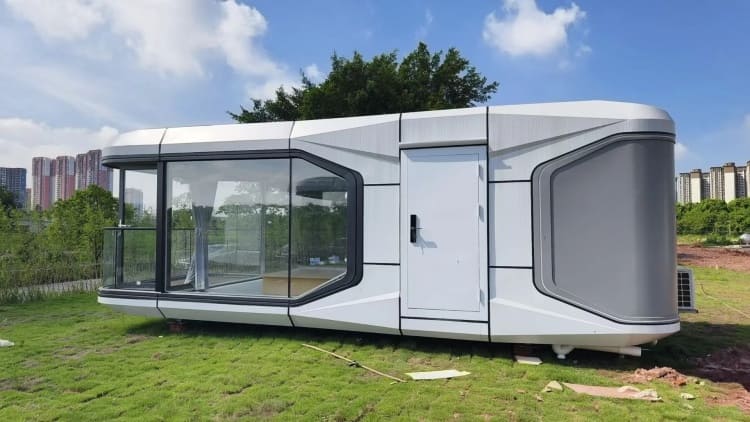
1️⃣ Capsule Home Utility Needs at a Glance
Bottom line: The first step in designing a capsule home’s utility system is calculating your actual water and power usage — then deciding whether to go on-grid or off-grid based on those numbers.
| Need | On-Grid / Municipal Option | Off-Grid Option |
|---|---|---|
| Water Supply | Standard pipe connection to municipal line | Rainwater harvesting + storage tank (500L+ recommended) + three-stage filtration |
| Power Supply | Standard utility meter connection | Solar panels (300W-450W per panel) + LiFePO4 battery (5-10kWh minimum) + inverter |
| Safety Baseline | Leak detectors, circuit breakers, smoke alarms | Same, plus a dedicated low-voltage protector for off-grid systems |
Field note: On one of our projects in a mountainous southwestern region, the owner initially estimated daily water use based on typical city habits (~150L/person/day). The off-grid storage tank ran dry within two days. For off-grid capsule homes, we recommend a conservative estimate of 100-120L/person/day, with a 20% buffer built in.
2️⃣ Water Supply Installation
Bottom line: Choosing a capsule home’s water system comes down to three factors — water source, pipe material, and pressure control. Target pressure should stay between 40-60 PSI; anything above that range requires a pressure regulator.
Water Source Comparison
| Source Type | Best For | Pros | Considerations |
|---|---|---|---|
| Municipal line | Suburban areas with access points | Stable supply, low maintenance | Requires connection permits |
| Well + pump | Rural / mountainous areas | Independent of external supply | Needs regular water quality testing |
| Rainwater harvesting | Fully off-grid setups | Eco-friendly, low cost | Requires 3-stage filtration + disinfection; needs backup source during dry spells |
Pipe Material Comparison (the question owners ask most)
| Material | Relative Cost | Weather Resistance | Best Use Case |
|---|---|---|---|
| PVC | Low | Corrosion-resistant, but brittle in cold | Cold-water lines in warmer climates |
| PEX | Medium | Flexible, better frost resistance than PVC | Complex layouts, cold-climate installations |
| Copper | High | Most durable, 20+ year lifespan | Higher-budget, long-term projects |
Real-world example: A capsule home project in a northern region originally used PVC piping throughout. After the first winter, three sections cracked from freezing. During the retrofit, we replaced all outdoor and uninsulated sections with PEX pipe and added insulation wrap — zero failures across the following two winters. Takeaway: for regions averaging below 5°C (41°F), avoid using PVC in any uninsulated section.
Plumbing Connections & Wastewater Management
- Once the main water line is connected, install an emergency shut-off valve immediately — this is the first line of defense for water system safety
- Insulate pipes in cold climates, and pair with a tankless (on-demand) water heater to save both space and energy
- Greywater (sinks, showers): can be reused for irrigation or toilet flushing
- Blackwater (toilets): must be treated before disposal — a bio-septic system is typically the most cost-effective option for capsule homes
3️⃣ Electrical System Installation
Bottom line: Capsule home electrical systems should follow a three-layer structure — main panel + circuit breakers + solar energy storage. For off-grid setups, start with a 5kWh battery baseline and scale up based on actual appliance load.
Energy Source Comparison
| Option | Stability | Upfront Cost | Long-Term Cost | Best For |
|---|---|---|---|---|
| Grid connection | High | Low | Medium (utility bills) | Areas with grid access |
| Solar off-grid | Medium (weather-dependent) | High | Low | Remote / no-grid locations |
| Solar + grid hybrid | High | Medium-High | Low | Owners wanting stability and lower bills |
Common Appliance Power Draw (for load estimation)
| Device | Reference Wattage |
|---|---|
| LED lighting | 5-15W per fixture |
| Smart devices / router | 10-30W |
| Refrigerator | 100-200W |
| Electric water heater | 1500-3000W |
| Air conditioner / heater | 1000-2500W |
Note: High-draw appliances (water heaters, AC units) are the deciding variable in off-grid system sizing. Choosing inverter/DC-powered appliances can cut power draw by 30-50% for the same category of device — directly reducing how much battery capacity and solar panel wattage you’ll need.
Always confirm every appliance matches your region’s voltage standard (e.g., 110V in the US, 220V in Europe).
Circuit Installation Essentials
- A main panel plus circuit breakers is the first line of defense against overloads — as a standard safety margin (not unique to capsule homes, but especially important in small, high-density electrical layouts), size your breaker capacity at roughly 1.25x your total calculated load
- All wiring must be properly rated and grounded to prevent electric shock
- Install surge protectors, and use moisture-rated wiring and waterproof outlets in wet areas (bathroom, kitchen)
Smart Energy Features
- Pairing solar panels with battery storage improves self-sufficiency; a smart meter lets you track real-time usage
- Backup power: a UPS or small generator to cover extended cloudy stretches or grid outages
4️⃣ Common Challenges & Practical Fixes
| Challenge | Solution |
|---|---|
| Leaks / low water pressure | Switch to PEX or copper piping; add a booster pump for low pressure; inspect fittings quarterly |
| Power outages / overloads | Balance circuit loads; install surge protectors; keep a solar generator on hand for off-grid setups |
| Extreme climates | Insulate pipes in cold regions; use reflective insulation in hot climates to cut energy use |
| Limited space | Use multi-functional furniture and wall-mounted storage; leave access room for pipe/wire maintenance |
| Wastewater handling | Bio-septic systems and composting toilets reduce environmental impact |
Conclusion
There’s no one-size-fits-all utility solution for capsule homes — municipal connections prioritize stability, off-grid systems prioritize self-sufficiency, but both depend on built-in safety margins and regular maintenance. Based on our project history, roughly 80% of post-installation issues trace back to two root causes: underestimating water/power usage during the design phase, and choosing materials that don’t match local climate conditions. Getting the load calculations and material selection right up front avoids the vast majority of downstream problems.
Frequently Asked Questions
1. Can capsule homes be fully off-grid? Yes. With a combination of solar panels, rainwater harvesting, and a septic system, a capsule home can run entirely independent of municipal utilities — though you’ll want a backup plan for extended cloudy stretches or dry seasons.
2. What’s the best water heating system for a capsule home? A tankless (on-demand) water heater is the best fit, saving both space and energy in a compact footprint.
3. Are capsule home electrical systems safe? Yes, as long as installation is done by a licensed electrician and the system includes circuit breakers and surge protectors. An annual professional inspection is recommended.
4. How can I save energy in a capsule home? Prioritize LED lighting and inverter-based appliances, monitor usage with a smart meter, and stagger high-draw devices (water heater, AC) to avoid peak-load overlap.
Disclaimer: The technical parameters in this guide are general reference points. Always consult a licensed electrician and plumbing engineer for your specific installation, and follow local building and electrical codes, as requirements vary by region.