Skip to content
Folding container homes have moved well past the “temporary shelter” label. In 2025, they represent a serious, scalable, and design-forward approach to both residential living and commercial real estate. Whether you are a homeowner looking for an affordable retreat, a developer planning a glamping resort, or an entrepreneur exploring a new investment, this guide covers everything you need — from how these structures work and what design trends are shaping them, to where they are being deployed most profitably and how to build a business around them.
What Is a Folding Container Home?
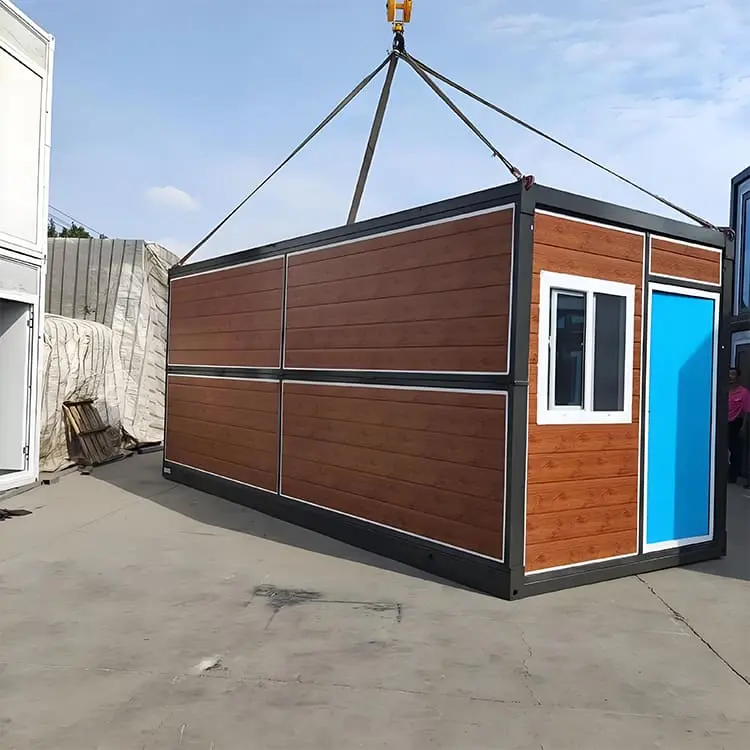
A folding container home is a prefabricated modular structure built around a steel frame that can be collapsed for transport and unfolded on-site for immediate use. Unlike conventional shipping container conversions that require cranes, extensive welding, and multi-week installations, a folding unit typically deploys in one to two days without heavy equipment.
The core technology relies on hinged wall panels and interlocking structural joints, allowing the home to ship flat and open up into a fully enclosed living space on arrival. Modern units are engineered to meet international building codes for wind resistance, fire safety, and thermal performance — making them legally viable for both residential and commercial applications in most markets.
Standard sizes range from single 20-foot units of roughly 15 to 20 square meters, up to multi-module configurations that combine two, four, or more units into a connected floor plan exceeding 100 square meters. The modular system means you are not locked into a fixed size; you can expand the structure as your needs grow.
Why Folding Container Homes Are Growing So Fast
Three forces are driving mainstream adoption right now.
Rising housing costs and land pressure. In most cities and popular tourist destinations, the cost of traditional construction has made small-scale development increasingly unviable. Folding container homes offer a lower cost per square meter, a compressed timeline from order to occupancy, and the flexibility to use land that would not justify a permanent build.
Shifts in how people live and work. The continued growth of remote work, the popularity of short-term rental platforms, and the demand for unique travel experiences have all created new use cases for structures that are affordable, distinctive, and quick to deploy.
Sustainability expectations. Buyers, travelers, and investors are increasingly choosing projects with a demonstrable environmental story. Folding container homes reduce material waste, are compatible with off-grid energy systems, and can be relocated rather than demolished when a site’s use changes — a meaningful advantage over poured-concrete construction.
Design Trends Reshaping Folding Container Homes
The design language of container homes has evolved significantly. The best projects in 2025 are indistinguishable from high-end boutique architecture — and several clear trends are driving that shift.
Smart Interiors and Multi-Functional Space
Compact living demands intelligent design. Designers are now integrating foldable partition walls, under-floor storage systems, voice-controlled lighting, and modular kitchen and bathroom pods that can be specified as a complete package. The result is what many in the industry call “smart minimalism” — a space that appears clean and uncluttered while concealing significant functional depth.
Biophilic Design and Natural Materials
Bringing the natural environment inside has become a defining feature of premium container home projects. Floor-to-ceiling glazing, skylights, natural ventilation paths, and the use of timber cladding, bamboo flooring, and cork panels all work toward the same goal: making a steel-framed structure feel warm, organic, and connected to its surroundings. This design direction is particularly powerful for eco-tourism applications, where guests expect both sustainability and sensory comfort.
Off-Grid Energy Independence
Solar panel integration, battery storage, rainwater harvesting, and greywater recycling systems are now standard options rather than specialist add-ons. For remote destinations — mountain sites, coastal plots, forest clearings — the ability to operate entirely off-grid is not just an environmental statement; it is a practical necessity and a strong marketing asset.
Modular Expansion and Stackable Configurations
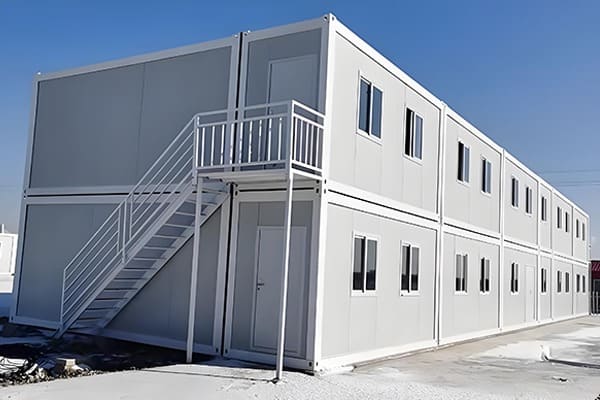
Single-unit thinking is giving way to modular master-planning. Architects and developers are now designing folding container projects as expandable systems — starting with two or four units and leaving structural provision for vertical or horizontal additions. L-shaped and T-shaped plans, second-story additions, and connected multi-bedroom layouts are all achievable through the same interlocking system, without the disruption of conventional construction.
Contemporary Exterior Aesthetics
Matte black, warm neutral, and earthy terracotta finishes have largely replaced the industrial grey default. Vertical timber slats, perforated Corten steel panels, and integrated green walls are being used to soften the structure’s lines and respond to the surrounding landscape. The visual identity of a well-designed folding container home today is closer to an architect-designed cabin than to a site office.
Top Applications in Tourism and Real Estate
The versatility of folding container homes makes them genuinely useful across a wide range of project types. These are the categories seeing the strongest growth.
Eco-Glamping Retreats and Nature Resorts
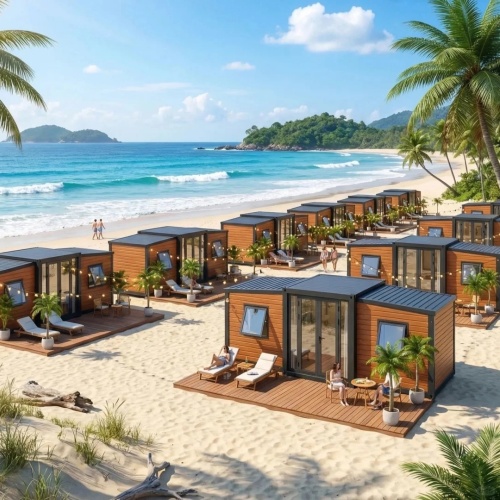
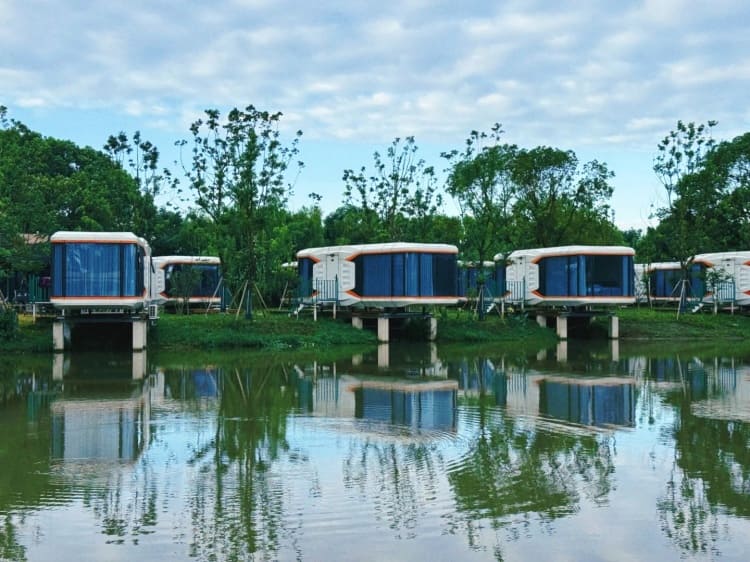
This is the highest-profile application right now. Sustainable tourism operators are using folding container units to develop fully-serviced glamping sites in remote or protected locations where permanent construction would be impractical or environmentally unacceptable. A typical unit for this use case includes a bedroom suite, compact bathroom, and a covered outdoor terrace, all powered by rooftop solar. Setup requires no concrete foundation — just leveled ground and anchor points.
Short-Term Vacation Rentals
For individual property owners, folding container homes offer a fast and relatively low-risk way to generate rental income from land that is sitting idle. A single well-positioned unit listed on Airbnb or a similar platform can achieve occupancy rates of 70 to 90 percent in a desirable location, with nightly rates that deliver a return on investment within two to three years. The structure can be relocated if the site does not perform — a flexibility no conventional build can match.
Affordable Housing and Urban Micro-Living
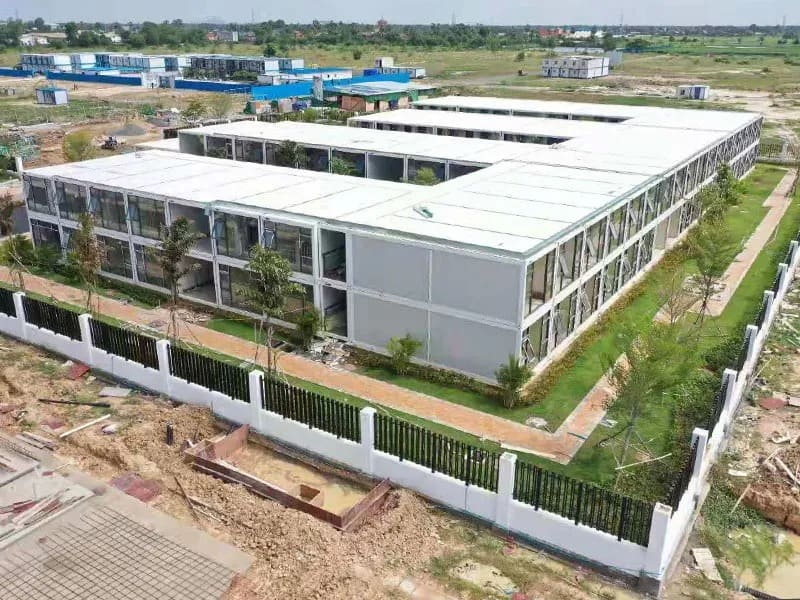
Governments, housing associations, and private developers are all exploring folding container homes as a response to urban housing shortages. Their low construction cost, fast deployment, and ability to stack vertically make them viable for student accommodation, co-living communities, transitional housing programs, and emergency shelter solutions. Several cities in Southeast Asia, Europe, and Latin America have completed pilot projects demonstrating that container-based housing can meet standard residential quality requirements at significantly lower cost than conventional construction.
Commercial Pop-Up and Mobile Business
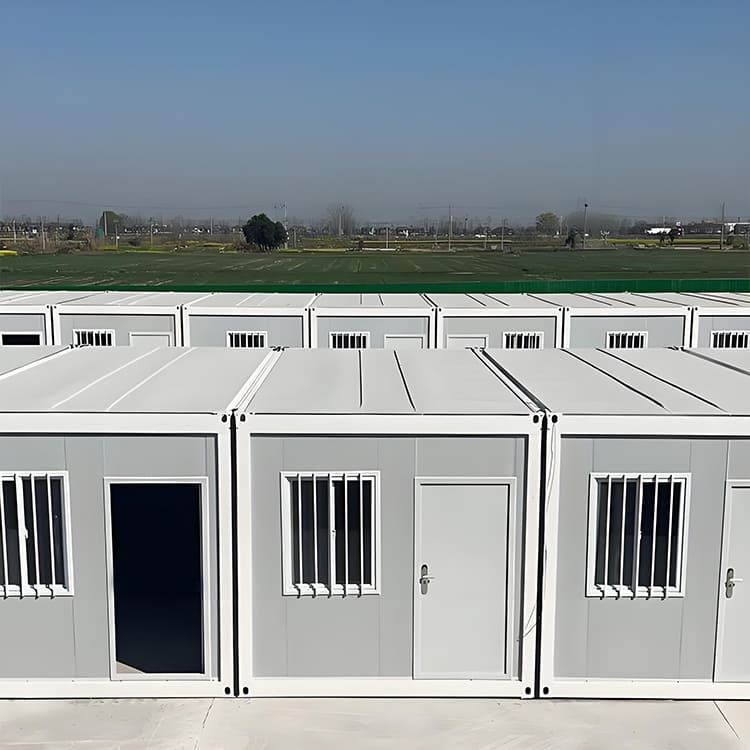
The folding mechanism is an advantage beyond residential applications. Pop-up retail stores, mobile cafés, site offices, exhibition pavilions, and mobile clinics all benefit from a structure that can be transported, installed, and relocated with minimal logistics complexity. For brands that want a physical presence at multiple locations across a season or event calendar, folding container units offer a cost-effective and visually distinctive alternative to conventional temporary structures.
How to Start a Folding Container Home Business
The same fundamentals that make folding container homes attractive to buyers and renters make them interesting for entrepreneurs. Here is how to approach the opportunity systematically.
Identify Your Market and Business Model
The four most viable business models are rental operations (glamping or vacation rental), long-term leasing (affordable housing or office), B2B supply (selling or leasing units to developers and event operators), and a franchise or branded service model (design, supply, and installation as a packaged service). Each has different capital requirements, timelines, and risk profiles. Rental operations tend to offer the fastest path to cash flow; B2B supply tends to offer greater volume at lower margin.
Partner with a Qualified Manufacturer
The quality of your end product depends entirely on your supply chain. Look for a manufacturer with engineering certifications for the target markets, documented quality control processes for steel specification and welding, the ability to offer customized layouts and turnkey interior packages, and a track record of completed projects you can verify. Visiting a factory before committing to a large order is worth the time and cost.
Understand Your Permitting Requirements
Modular and prefabricated structures are treated differently under building codes in different jurisdictions. Before purchasing land or committing to a project, confirm the local zoning classification, the permitting process for your intended use, and whether the structure will be treated as permanent or temporary construction. Obtaining engineering drawings and compliance documentation from your manufacturer early in the process significantly reduces approval delays.
Plan Your Finances Realistically
A single mid-range folding container unit for glamping use typically requires $20,000 to $50,000 in capital, covering the unit, transportation, site preparation, and basic furnishing. Logistics and installation add $3,000 to $8,000 depending on location. At a nightly rate of $80 to $200 and an occupancy rate of 70 to 90 percent, the payback period on a well-located unit is typically 12 to 24 months. Scale the model by adding units incrementally as cash flow allows.
Build Visibility Through the Right Channels
For tourism-oriented businesses, high-quality photography and video content are non-negotiable. Listing on Airbnb, Booking.com, and relevant glamping-specific platforms provides immediate reach. Social media — particularly Instagram and Pinterest for visual appeal — drives awareness and direct bookings. For B2B models, a professional website optimized for search terms like “folding container home supplier” or “prefab glamping units” and an active presence at relevant trade events are more effective than consumer-facing channels.
The Investment Outlook
The global prefabricated housing market is on a strong growth trajectory, with container-based units among the fastest-expanding segments. The combination of rising land values, housing affordability pressures, growing eco-tourism demand, and improving design quality is creating a durable market for folding container home products across both developed and emerging economies.
Entrepreneurs and investors who enter the market early — with a clear use case, a quality supply relationship, and a disciplined approach to site selection and financial planning — are well positioned to benefit from adoption that is still in its early stages in most markets.
Conclusion
Folding container homes are no longer a niche curiosity. They are a mature, multi-application building system that delivers real value for homeowners, tourism operators, urban developers, and commercial businesses. The design capabilities available in 2025 mean there is no longer a trade-off between affordability and quality — the best folding container projects compete directly with conventional architecture on aesthetic grounds, while retaining the speed, flexibility, and sustainability advantages that make the category distinctive.
Whether your interest is personal, commercial, or investment-oriented, the fundamentals favor action sooner rather than later.
Ready to explore folding container home solutions for your project? Contact our team for customized design options, technical specifications, and a detailed project quote.
FAQ — Frequently Asked Questions About Folding Container Homes
Q1: What exactly is a folding container home, and how is it different from a regular shipping container conversion?
A folding container home is a purpose-built prefabricated structure with hinged wall panels and interlocking steel joints that allow it to be collapsed flat for shipping and unfolded on-site into a fully enclosed living space. A conventional shipping container conversion, by contrast, starts with a retired cargo container that requires extensive cutting, welding, insulation installation, and often crane lifting — a process that can take weeks. A folding unit typically deploys in one to two days without heavy equipment, making it significantly faster and more cost-effective for projects that require quick setup or future relocation.
Q2: How long does it take to install a folding container home?
Most standard single or double units can be assembled and made move-in ready within one to three days, depending on site conditions and the level of interior fit-out required. Multi-unit configurations or projects requiring a prepared concrete foundation may take five to ten days. This is dramatically faster than conventional construction, which typically runs from several weeks to several months for a comparable footprint.
Q3: How durable are folding container homes? Can they handle extreme weather?
When manufactured to engineering standards, folding container homes are highly durable structures. The primary frame is typically built from Q345 or equivalent structural steel, which offers strong resistance to wind loading, snow load, and seismic activity. Most certified units are rated to withstand wind speeds of 120 km/h or higher. The key factors are the quality of the steel specification, the integrity of the joints and welds, and the quality of the weatherproofing applied to the roof and wall connections. Buying from a manufacturer with documented engineering certifications and third-party testing is the most reliable way to ensure your unit performs in your local climate.
Q4: Are folding container homes suitable for year-round living in cold or hot climates?
Yes, but the insulation specification must match your climate zone. Metal conducts heat and cold with almost no inherent resistance, so the thermal performance of a container home is entirely determined by the insulation system installed. Cold climates require high R-value spray polyurethane foam or SIP panels. Hot, humid climates need vapor barriers alongside insulation to prevent condensation and mold. A manufacturer that offers climate-specific insulation packages is preferable to one with a single standard build. When properly specified, folding container homes achieve energy performance comparable to conventional residential construction.
Q5: Do I need a building permit for a folding container home?
This depends entirely on your local jurisdiction, the intended use (residential vs. commercial), and whether the structure will be classified as permanent or temporary. Many regions now have clear permitting pathways for modular and prefabricated structures, but requirements vary widely. You will typically need architectural drawings, an engineering report, and compliance documentation for fire, wind, and energy codes. The most reliable approach is to confirm requirements with your local planning authority before purchasing land or ordering units. A qualified manufacturer should be able to provide the documentation most jurisdictions require.
Q6: Can a folding container home be expanded after installation?
Yes — this is one of the format’s most practical advantages. Because the units are built on a modular system, additional units can be connected horizontally to extend floor area, or stacked vertically to create a two-story layout. Many buyers start with one or two units and expand as their budget or business grows. For this to work smoothly, it is important to discuss your expansion plans with your supplier before the initial installation, so that structural connection points and utility stubs can be positioned correctly from the outset.
Q7: What is the lifespan of a folding container home?
A well-maintained folding container home built from quality steel with proper corrosion protection has a service life of 20 to 30 years or more. The primary maintenance requirements are periodic inspection and touch-up of the anti-corrosion coating, checking the waterproof seals around windows and roof connections, and ensuring drainage around the foundation remains clear. Homes used in coastal or high-humidity environments require more frequent inspection of the exterior finish.
Q8: What does a folding container home typically cost, and what is the ROI for rental use?
A mid-range single unit configured for short-term rental or glamping use — including insulation, basic interior fit-out, and a bathroom module — typically costs between $20,000 and $50,000 depending on size, specification, and your location. Transportation and site preparation add $3,000 to $8,000. For rental applications in well-chosen locations, nightly rates of $80 to $200 and occupancy rates of 70 to 90 percent are achievable, translating to a payback period of 12 to 24 months. High-end custom units with luxury finishes can command nightly rates well above this range and deliver strong returns for boutique hospitality projects.
Q9: Is a folding container home environmentally friendly?
Compared with conventional construction, folding container homes generate significantly less on-site waste, require less raw material per square meter of living space, and can be deconstructed and relocated rather than demolished at end-of-use. Many units are designed to integrate solar panels, rainwater harvesting, and greywater recycling, enabling off-grid operation with a minimal environmental footprint. The steel frame is itself fully recyclable. For buyers with sustainability goals, the format offers a credible and auditable environmental position relative to most conventional alternatives.
Q10: How do I choose a reliable folding container home supplier?
Look for four things: a factory you can visit or verify through video walkthrough; documented engineering certifications for your target market; a willingness to provide an itemized quote rather than a lump-sum price; and clear warranty terms covering structural defects, weatherproofing, and key components. Ask for completed project references and, where possible, speak directly with previous customers. Suppliers who cannot explain their steel specification, insulation system, or quality control process in specific terms should be treated with caution. The cheapest quote rarely reflects the true cost of ownership over a five- to ten-year horizon.