Skip to content
Wondering whether your capsule house dreams will fit inside a standard 20-foot shipping container?
You’re right to check — every millimeter matters when customs doors, cranes, and container limits are involved.
This guide explains how to match your capsule house dimensions with container capacity, pack efficiently, and prepare all required documents — ensuring your project ships smoothly without delays.
1. Comparing Capsule House Dimensions with a 20-Foot Container
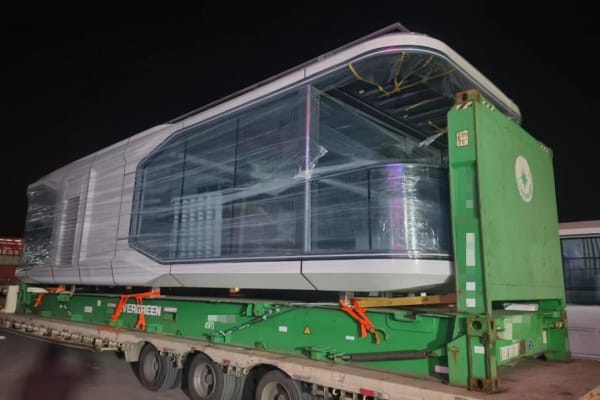
Before booking freight, it’s essential to understand how your capsule home compares with a standard 20-ft container. This ensures smooth transport, legal compliance, and damage-free delivery.
i) Internal Measurements of a 20ft Container
| Specification | Metric (m) | Imperial (ft/in) |
|---|---|---|
| Length | 5.9 m | 19 ft 4 in |
| Width | 2.35 m | 7 ft 8 in |
| Height | 2.39 m | 7 ft 10 in |
These dimensions define your usable packing volume — every wall panel, frame, or packaged item must stay within these limits.
ii) Typical Capsule House Sizes
Most capsule homes are designed with container dimensions in mind, but always confirm before production.
| Component | Range (m) | Fit Status |
|---|---|---|
| Length | 4.5–5.8 m | ✅ Fits Easily |
| Width | 2.0–2.2 m | ✅ Within Allowance |
| Height | 2.2–2.35 m | ✅ Safe Clearance |
👉 Always recheck measurements after adding insulation, packaging, or modular extensions.
iii) Quick Fit-Check Tips
(Insert image: measuring tape and CAD sketch)
-
Measure all components, including packaging and removable parts.
-
Compare length, width, and height against the container’s door opening (smaller than interior space).
-
Allow a few centimeters for foam padding or wrapping.
✅ Pro Tip: Always confirm with a CAD layout before booking freight.
iv) Why CAD Drawings Are Essential
Using Computer-Aided Design (CAD) lets you model how every component fits inside the container.
-
Identify overlapping or space-wasting arrangements early.
-
Adjust configurations before fabrication.
-
Prevent costly rework or shipment delays.
Skipping CAD planning can result in poor space use or customs rejection due to size errors.
2. Smart Packing Techniques to Maximize Container Space

Efficient packing is key to prevent damage and reduce freight costs.
i) Heavy-to-Light Layering
-
Bottom: Place heavy elements like steel frames or flooring sections.
-
Top: Add lightweight components such as insulation panels, windows, or roofing sheets.
This creates balance, prevents crushing, and stabilizes the load.
ii) Use Vertical Space Effectively
Utilize the full height (2.39 m) carefully:
-
Position long panels vertically or horizontally, depending on shape.
-
Use ropes or wooden supports to prevent falling or sliding.
Proper stacking saves space — but must be done safely.
3. Protecting Your Capsule House During Shipping
The road to your destination may include rough handling, so protection is vital.
i) Securing and Reinforcement
-
Use industrial straps or belts to hold items firmly.
-
Add wooden or metal bracing inside for rigidity.
-
Prevent internal shifts during transit.
ii) Anti-Shifting and Stabilization
-
Insert rubber pads, foam blocks, or wooden wedges to absorb motion.
-
Secure all components against vibration or sharp turns.
iii) Glass and Fragile Components
-
Wrap glass in bubble wrap or foam.
-
Place within wooden corners or crates.
-
Label as Fragile – Handle with Care.
-
Never stack heavy parts on top of glass sections.
4. Common Shipping Mistakes and How to Avoid Them
Container shipping for prefab houses requires precision. Avoid these costly mistakes:
i) Oversize Errors
Small design oversights — like roof fittings or solar mounts — can push you into the “oversized load” category.
Typical Miscalculations:
-
Forgetting trailer height when on a truck.
-
Ignoring external add-ons like AC units or steps.
-
Allowing internal bulges that distort walls.
Consequences:
Delays, customs rejection, or full repacking (plus extra charges).
Prevention Tips:
-
Verify total loaded height and external fittings.
-
Check legal limits for bridges and highways.
-
Confirm with your freight forwarder before dispatch.
ii) Internal Furniture and Fixture Security
Loose furniture causes damage and imbalance during movement.
Securing Checklist:
-
Tie down furniture using ropes or straps.
-
Wrap edges and corners with foam.
-
Use wooden or metal supports for heavy items.
-
Stack carefully and distribute weight evenly.
iii) Pre-Shipment Inspection Checklist
Before sealing your container:
✅ All items secured
✅ Dimensions verified
✅ Glass wrapped
✅ Photos taken for insurance
✅ Load map + packing list attached
✅ No loose wires or fittings
iv) Know the Key Shipping Documents
Proper paperwork prevents customs delays or fines.
| Document | Purpose |
|---|---|
| Bill of Lading (B/L) | Confirms shipment & ownership |
| Commercial Invoice | Declares value and sale details |
| Packing List | Lists all parts, weights, and sizes |
| Certificate of Origin | Confirms manufacturing country |
| Shipper’s Letter of Instruction (SLI) | Freight instructions |
| Export/Import License | For restricted or regulated goods |
| Insurance Certificate | Covers loss or damage |
| Inspection Certificate | Verifies quality & safety |
| Fumigation Certificate | Required for wooden packaging |
| HS Codes | Classifies product for customs |
⚙️ Always check your prefab’s compliance with international standards for insulation, wiring, and fire safety.
Summary: Plan Smart, Ship Smoothly
A well-planned capsule house shipment saves time, money, and stress.
✅ Measure accurately.
✅ Use CAD for packing layout.
✅ Secure heavy and fragile parts correctly.
✅ Double-check paperwork before export.
By combining precise sizing, safe packing, and complete documentation, you’ll ensure your capsule house reaches its destination safely and legally.
Frequently Asked Questions (FAQ)
1. Can every capsule house fit inside a 20-ft container?
Most can — as long as packed dimensions stay under 5.9 m × 2.35 m × 2.39 m.
2. What if my capsule house exceeds container size?
You may need a 40-ft container or flat-rack shipping, often with extra cost and permits.
3. How can I prevent damage during shipping?
Use layered packing, secure items with straps, and protect glass with foam or wood crates.
4. Do I need special export licenses?
Check your country’s export control rules — prefab units with certain materials may require licenses.
5. What is the most common customs issue?
Incomplete documentation or incorrect HS codes — always confirm with your freight forwarder.